 visitkiato.com
Isthmus of Corinth
↗ Nearby escape: this destination is outside the Municipality of Sikyona — an easy day trip with Kiato as your base.
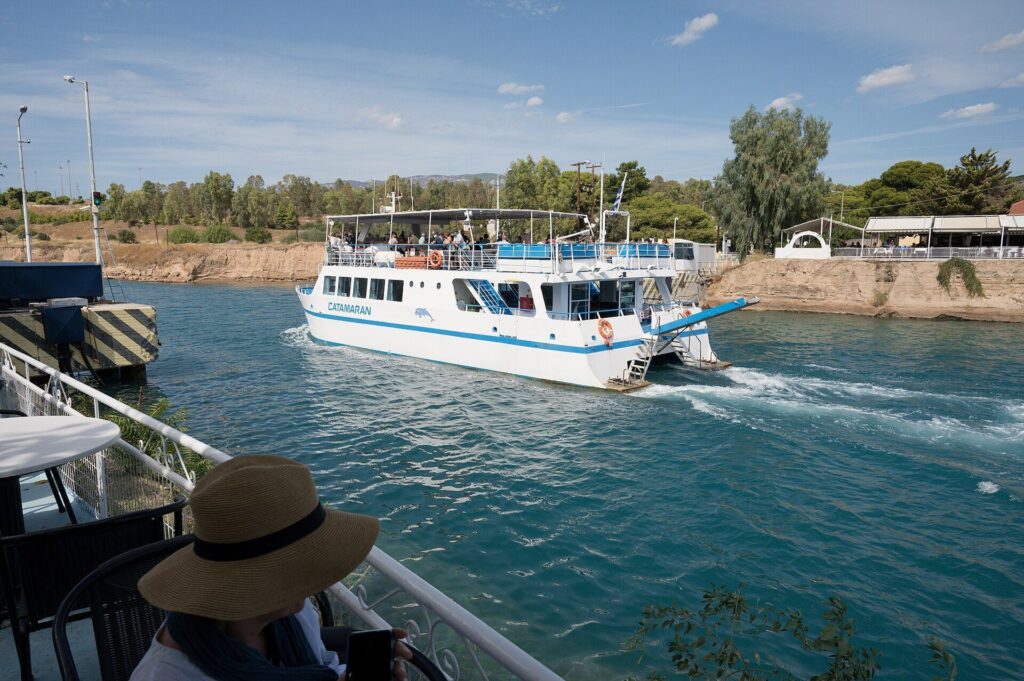
The Isthmus of Corinth is a narrow strip of land that connects mainland Greece with the Peloponnese, while the canal that has been opened in it connects the Saronic Gulf with the Gulf of Corinth. It is about 6 kilometres long and the narrowest point is where the Corinth Canal was constructed (1880-1893). It was a strategic point and for this reason, a wall had already been built by the ancient times (late 5th century BC), which had been preserved until the Byzantines (Hexamilion).
The Isthmus of Corinth was known in the ancient world as the landmark that separated the Peloponnese from the rest of mainland Greece. In the 1st century AD, geographer Strabo pointed out a column on the Isthmus of Corinth that bore two inscriptions. One towards the east, i.e. Megara of Attica, which said: “This is not Peloponnese, but Ionia” and the other towards the west, i.e. the Peloponnese: “This is Peloponnese, not Ionia”. Plutarch attributed the erection of this column to the hero of Attica, Theseus, on his way to Athens.
From 1893, a 6.3 kilometre-long isthmus canal, the Corinth Canal, has been open, which practically makes the Peloponnese an island. Today, two road bridges, two railway bridges, and two submerged bridges at the two ends of the canal connect the mainland side of the isthmus with that of the Peloponnese. There is also a military emergency bridge at the western end of the canal.
The idea of a shortcut so that sailing vessels do not sail around the Peloponnese had been examined for a long time by the ancient Greeks. The first attempt to open a canal there was made by the tyrant Periander in the 7th century BC. He abandoned the project due to technical difficulties and instead built a simpler and less expensive land stone ramp, called Diolkos, as a passage road. Remains of the Diolkos still exist today next to the modern canal. When the Romans gained control of Greece, several different solutions were attempted. Julius Caesar foresaw the benefits of a connection for the newly founded Corinth as Colonia Laus Iulia Corinthiensis. During the reign of Tiberius, engineers attempted to dig a canal but failed due to a lack of modern equipment. Instead, they constructed an Ancient Egyptian mechanism: boats were rolled along the isthmus on tree trunks, just as the Egyptians had rolled granite pieces to build their pyramids. This was put into operation in 32 AD. In 67 AD, the Philhellenic Roman emperor Nero ordered 6,000 slaves to dig a canal with shovels. The historian Josephus Flavius wrote that the 6,000 slaves were Jewish pirates who were captured by Vespasian during the Jewish Wars.
The idea was first seriously proposed in the modern era in 1830, immediately after Greece’s liberation from the Ottoman Empire, and was completed in 1893 after eleven years of work.
Map: see the online page (QR code below).
Things to do there — Kiato & Corinthia
Optional tours, tickets and activities for your days here — you choose what suits you.
Activities, experiences and local guides — book ahead and skip the queues.
See options →A guided day with transport from Athens to Ancient Corinth and Nafplio, with free cancellation. Also: Corinth Canal & wine tasting, Ancient Corinth half-day
See options →Compare prices from all the major rental companies, with free cancellation on most offers. Also: Loutraki, Nafplio, Argos
See options →Activities are provided and sold by our partners. You complete the booking on their own page, at exactly the same price.
Scan to open the page with maps, photos and updates.
Printed on: 09/10/2026