 visitkiato.com
Nemea
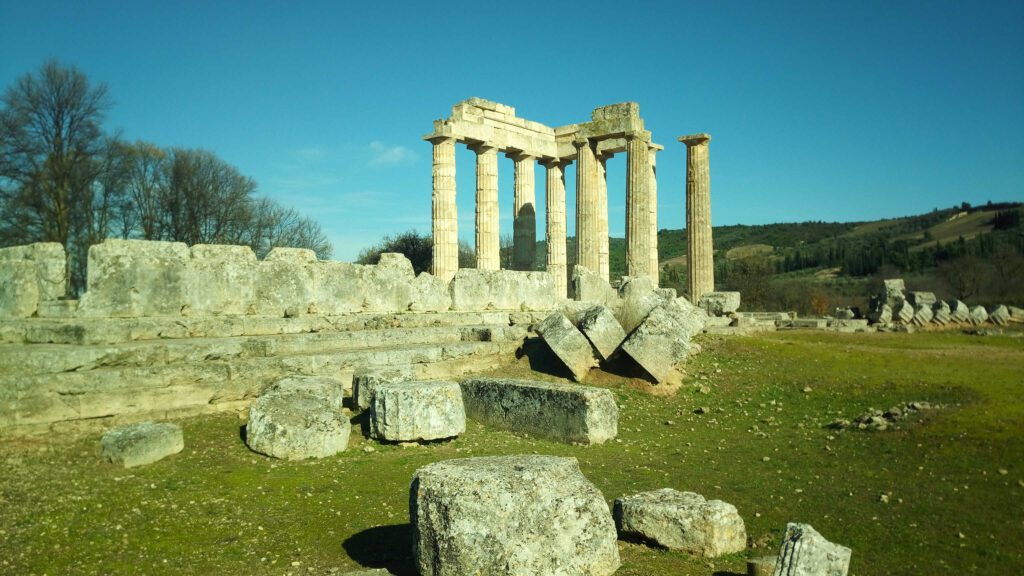
The valley that gave its name to the Agiorgitiko grape, with an archaeological site that hides the stadium where the athletes of the Nemean Games once ran.
Why it is worth it
- The Temple of Zeus and the Archaeological Museum.
- The ancient stadium with its vaulted athletes' entrance.
- Wineries that welcome visitors for tastings.
- The setting of Heracles' first labour — the Nemean lion.
↗ Nearby escape: this destination is outside the Municipality of Sikyona — an easy day trip with Kiato as your base.
The Nemean Games, along with the Olympic, Delphic, and Isthmian Games, were the four panhellenic athletic competitions where the only reward for athletes was a wreath. The ancient written sources date the establishment of the Nemean Games to 573 BC in historical times, and excavations have fully confirmed this. Indeed, one of the earliest inscriptions mentions four victories in the sport known as pankration by a local athlete, Aristios from Kleones, possibly as early as 567 BC.
Although the sanctuary and games appeared to be under the supervision of the Cleonaeans, it is evident that ultimate power was exercised by Argos. This may have resulted from the alliance of Argos and Athens, which caused the violent destruction of Nemea during the Peloponnesian War, when Sparta conducted military operations focused on Nemea, in 419/18 and 415/4 BC (Thucydides 5.58-60 and 6.95, respectively).
After this destruction, the sanctuary remained in ruins for about 75 years. The games continued to be held, but in Argos. At some point, not far from 330 BC, the games returned to Nemea, as evidenced by the implementation of an extensive building program, which included the Temple of Zeus and the Early Hellenistic Stadium. This program likely attests to a Macedonian role that was played in Nemea, especially by Philip and his son Alexander the Great.
The Games at Nemea did not last long and in 271 BC they were transferred back to Argos. Nemeonikai are recorded throughout the rest of antiquity, but not in Nemea itself. When Pausanias visited it around 150 AD, he found the Temple of Zeus in ruins, with a fallen roof and without the cult statue. This may be the work of the famous Lysippus, who was later recognised.
Map: see the online page (QR code below).
Things to do there — Kiato & Corinthia
Optional tours, tickets and activities for your days here — you choose what suits you.
Activities, experiences and local guides — book ahead and skip the queues.
See options →A guided day with transport from Athens to Ancient Corinth and Nafplio, with free cancellation. Also: Corinth Canal & wine tasting, Ancient Corinth half-day
See options →Compare prices from all the major rental companies, with free cancellation on most offers. Also: Loutraki, Nafplio, Argos
See options →Activities are provided and sold by our partners. You complete the booking on their own page, at exactly the same price.
Scan to open the page with maps, photos and updates.
Printed on: 14/10/2026