
23/01/2026· Blog
The mythology of Sikyonia
The land of Sikyonia is full of myths — from the labours of Heracles to the artists of Ancient Sikyon.
The Stymphalian birds
At Lake Stymphalia, Heracles faced the Stymphalian birds — his sixth labour. Today the lake is a protected wetland.
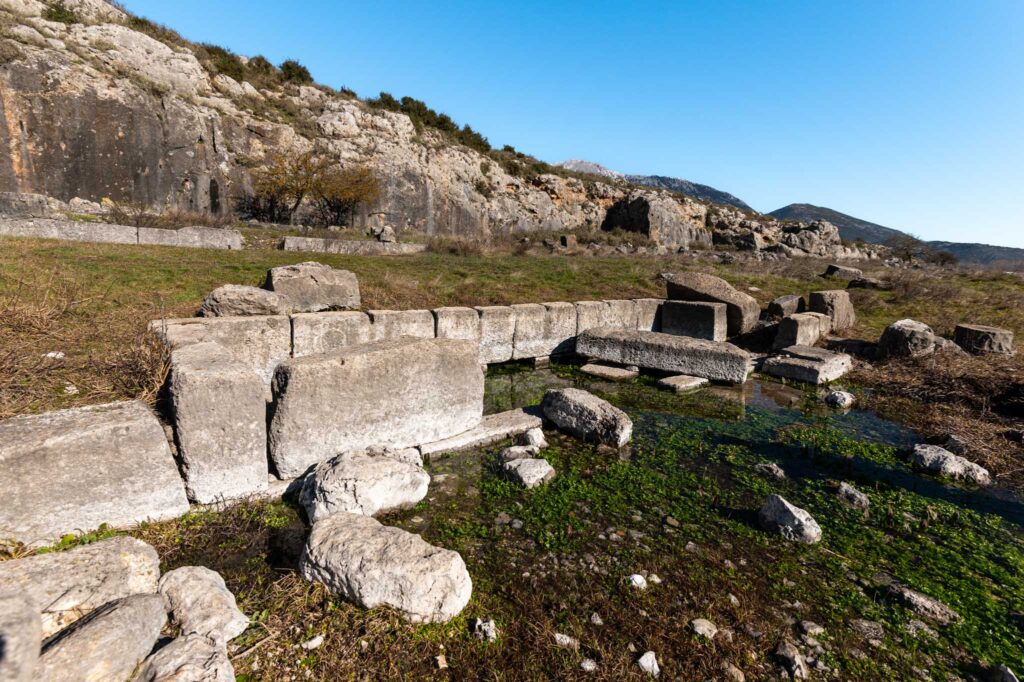
Glorious Sikyon
Ancient Sikyon was renowned for its painting and sculpture, giving the world great artists of antiquity.
Walk in the footsteps of myth with our map.
Mecone: Where Gods and Mortals Divided the World
Long before it was known as Sikyon, the land was called Mecone. It is here, according to Hesiod, that one of the most pivotal moments in Greek mythology occurred: the trickery of Prometheus. At a great assembly of gods and mortals, the Titan Prometheus was tasked with deciding how a sacrificed ox should be divided between the Olympians and humans.
Prometheus, seeking to favor humanity, wrapped the best meat and entrails inside the animal’s stomach (an unappealing sight) and placed the white bones inside a layer of glistening fat. He invited Zeus to choose. Zeus, deceived by the appearance of the fat, chose the bones, establishing the precedent that humans would keep the nourishing meat while burning the bones and fat as offerings to the gods. Enraged by this deception, Zeus withheld fire from mankind, leading Prometheus to steal it from Olympus and bring it back to the people of Mecone in a hollow fennel stalk. When you stand on the plateaus overlooking the Corinthian Gulf today, you are standing on the very ground where the relationship between the divine and the earthly was forever codified.
The Royal Lineage of the Aegialeans
Sikyonia boasts one of the oldest king-lists in ancient Greece, tracing its roots back to Aegialeus, the first inhabitant and founder of the city. The mythic history of the region is a tapestry of names that appear throughout the great epics. King Lamedon, for instance, is said to have sought the help of Sicyon from Attica during a war, eventually naming the city after him. This era of legendary kings bridges the gap between the age of heroes and the historical record, positioning Sikyonia as a primary cradle of Peloponnesian civilization.
The Sanctuary of Titani and the Healing Touch of Asclepius
High in the hills of Sikyonia lies Titani, a place of immense spiritual significance in antiquity. According to local legend, the sanctuary here was founded by Alexanor, the grandson of Asclepius, the god of medicine. Unlike many other shrines, Titani held a special status as a direct descendant of the Epidaurian cult, but with its own unique local traditions.
The myth tells us that Alexanor built the sanctuary to honor his grandfather, and it became a renowned center for healing. Ancient travelers, including Pausanias, noted that the cult statue of Asclepius was draped in a tunic of white wool and a cloak, a rare detail that highlighted the intimate and protective nature of the god in this region. The air in Titani, even today, carries a sense of serenity that explains why the ancients believed the gods chose this specific mountain ridge to bestow the gift of health upon mortals.
The Engineering Labours of Heracles in Feneos
While the Stymphalian birds are Heracles’ most famous association with the area, the high plateau of Feneos served as the backdrop for even more dramatic feats of mythic engineering. The basin of Feneos was often plagued by floods, and the locals attributed the drainage systems to the strength of Heracles himself.
Mythology states that Heracles dug deep pits, known as katavothres (sinkholes), and even carved a massive canal to redirect the waters of the Olbios River. He did this to reclaim the fertile land for the people of Feneos, showcasing his role not just as a monster-slayer, but as a civilizing force who tamed the wild elements of the Peloponnese.
The Gateway to the Underworld
The deep waters of Lake Feneos were also shrouded in darker mysteries. It was whispered in antiquity that the lake possessed an entrance to the Underworld. According to some accounts, it was from here that Demeter descended into the realm of Hades during her desperate search for Persephone. The Feneatians maintained a sacred tradition involving the “Petroma,” a pair of large stones containing secrets related to the Eleusinian Mysteries, which were kept in the temple of Demeter Thesmia. This deep connection to the chthonic gods makes the Feneos valley one of the most spiritually complex landscapes in all of Sikyonia.
Hermes and the Caves of Mount Kyllini
Dominating the skyline of Sikyonia is the majestic Mount Kyllini (Ziria), the second-highest peak in the Peloponnese and the mythical birthplace of Hermes. The messenger of the gods was born in a deep cave on the mountain’s slopes to Maia, one of the Pleiades.
The myths surrounding Hermes’ infancy in Sikyonia are filled with mischief and wonder:
- On the very day he was born, Hermes is said to have invented the lyre by stretching sheep guts over the shell of a tortoise he found outside his cave.
- He famously stole the sacred cattle of Apollo, hiding them in the rugged terrain of the Sikyonian and Feneatian borders, using clever tricks like making the cows walk backward to confuse any trackers.
- The “Hermes Cave” on the western slopes of the mountain remains a site of pilgrimage for those fascinated by the god of travelers, thieves, and merchants.
Adrastus and the Tragic Echoes of the Seven Against Thebes
Sikyon played a central role in one of the most famous epic cycles of Greek myth: the expedition of the Seven Against Thebes. King Adrastus of Argos fled to Sikyon after a conflict and eventually ascended to its throne. It was from this land that he helped organize the ill-fated campaign to restore Polynices to the Theban throne.
The city of Sikyon long maintained a “heroon” (a shrine to a hero) dedicated to Adrastus in its agora. For centuries, the people of Sikyon honored his memory with tragic choruses, predating the development of formal Attic theater. This deep-rooted tradition of storytelling and performance linked the city’s political identity to the heroic age, ensuring that the sorrows and triumphs of Adrastus remained a living part of the Sikyonian landscape. When the tyrant Cleisthenes later attempted to suppress the cult of Adrastus, it sparked a cultural revolution, showing just how deeply these myths were woven into the fabric of local life.
Dionysus and the Gift of the Vine
The rolling hills of Sikyonia, which today produce some of Greece’s finest wines, have been associated with Dionysus since the dawn of time. In local lore, the god of wine was not a distant figure but a frequent visitor to the groves of the region. The Sikyonian people claimed a special connection to the “Dionysus Bakcheios,” and his presence was celebrated in festivals that utilized the region’s natural amphitheaters. The mythic foundation of the Sikyonian theater—one of the largest in ancient Greece—is inextricably linked to the rituals performed in his honor, turning the hillsides into a stage where the boundary between the human and the divine blurred through song, wine, and dance.
See it on an organised trip
Organised excursions by Lia’s Travel, departing from Kiato and Corinthia.
Sights & things to do nearby
All of them inside the Municipality of Sikyona — Kiato and its villages.
Take this page with you
Scan with your phone camera to open it on the go.
Things to do there — Kiato & Corinthia
Optional tours, tickets and activities for your days here — you choose what suits you.
Activities, experiences and local guides — book ahead and skip the queues.
See options →A guided day with transport from Athens to Ancient Corinth and Nafplio, with free cancellation. Also: Corinth Canal & wine tasting, Ancient Corinth half-day
See options →Compare prices from all the major rental companies, with free cancellation on most offers. Also: Loutraki, Nafplio, Argos
See options →Activities are provided and sold by our partners. You complete the booking on their own page, at exactly the same price.
Before you arrive
Land in Kiato already connected
Skip the SIM counter and the roaming bill. MyEsim is a Greek eSIM app — you set the plan up at home and it activates the minute you land, so the map works before you even leave the station. Visit Kiato readers get 10% off.
- 180+ countries
- Ready in minutes
- Support in English & Greek
Enter the code at checkout on myesim.gr. Works on iPhone XS and newer and on most Android phones from 2019 onwards.